In today’s digital landscape, our reliance on USB-powered and connected devices is ever-growing, from external hard drives and printers to webcams, keyboards, and mice. However, the number of USB ports on our computers often feels insufficient, leading to a frustrating juggle of cables and devices. This is where USB hubs and switches become indispensable tools, transforming your workspace by expanding your connectivity and streamlining how you manage multiple peripherals across different systems. This comprehensive guide will demystify these essential devices, helping you understand their distinct functions, explore various types, and make an informed decision to optimize your setup.
Understanding USB Connectivity: Hubs vs. Switches
|
Our Picks for the Best USB Hub in 2026
As an Amazon Associate I earn from qualifying purchases.
|
||
| Num | Product | Action |
|---|---|---|
| 1 | Anker 555 USB-C Hub (8-in-1), with 85W Power Delivery, 4K 60Hz HDMI Port, 10Gbps USB C and 2 A Data Ports, Ethernet microSD SD Card Reader, for MacBook Pro More |

|
| 2 | Anker USB Hub 4 Ports, Multiple USB 3.0 Hub, USB Splitter for Laptop, Extender for A Port Laptop, PC, Desktop and More [Charging Not Supported](2ft USB-A) |
|
| 3 | 13 in 1 USB C Docking Station - Dual Monitor, Triple Display, 8 USB C/A Ports, Ethernet, Audio - LIONWEI USB C Hub for MacBook,Dell,HP,Lenovo,Surface |
|
| 4 | Acer USB C Hub, 7 in 1 Multi-Port Adapter for Laptop, 4K, HDMI Splitter with 2 USB A 3.1 & Type-C to HDMI Data Port, PD 100W Charging, SD Card Reader for Computer, Desktop, Space Grey |
|
| 5 | PWAY USB 2.0 Switch, USB Switcher Selector 2 Computers Sharing 4 USB2.0 Ports, KVM Switch Devices Peripheral Hub for Keyboard Mouse Printer Scanner Compatible with Windows Mac Linux |
|
| 6 | ONFINIO USB Hub 3.0, 7-Port USB Hub Splitter with Individual On/Off Switches and Lights, 3.2ft/1m Long Cable Compatible with MacBook, Laptop, Surface Pro, PS4, PC, Flash Drive, Mobile HDD |
|
| 7 | Powered USB Hub, Wenter 11-Port USB Splitter Hub (10 Faster Data Transfer Ports+ 1 Smart Charging Port) with Individual LED On/Off Switches, USB Hub 3.0 Powered with Power Adapter for Mac, PC |
|
| 8 | Acer USB Hub 4 Ports, Multiple USB 3.0 Hub, USBA Splitter for Laptop with Type C Power Port, Extender for A Port Laptop, PC, Desktop and More (2ft) |
|
| 9 | UGREEN USB 3.0 Hub, 4 Ports USB A Splitter Ultra-Slim USB Expander for Mouse, Keyboard, Flash Drive, U Disk, Printer Compatible with Laptop, Desktop PC, Xbox, PS5, and More |
|
| 10 | USB-C Hub 7-in-1 Multiport Adapter – 4K@30Hz HDMI, USB 3.0, USB 2.0, 100W PD Charging, SD/TF Card Reader – USB-C Docking Station for MacBook Pro/Air, Chromebook, Dell, HP & Type-C Devices |
|
While often confused, USB hubs and USB switches serve fundamentally different, yet complementary, purposes. Understanding this distinction is the first step toward building an efficient and clutter-free workstation.
What is a USB Hub?
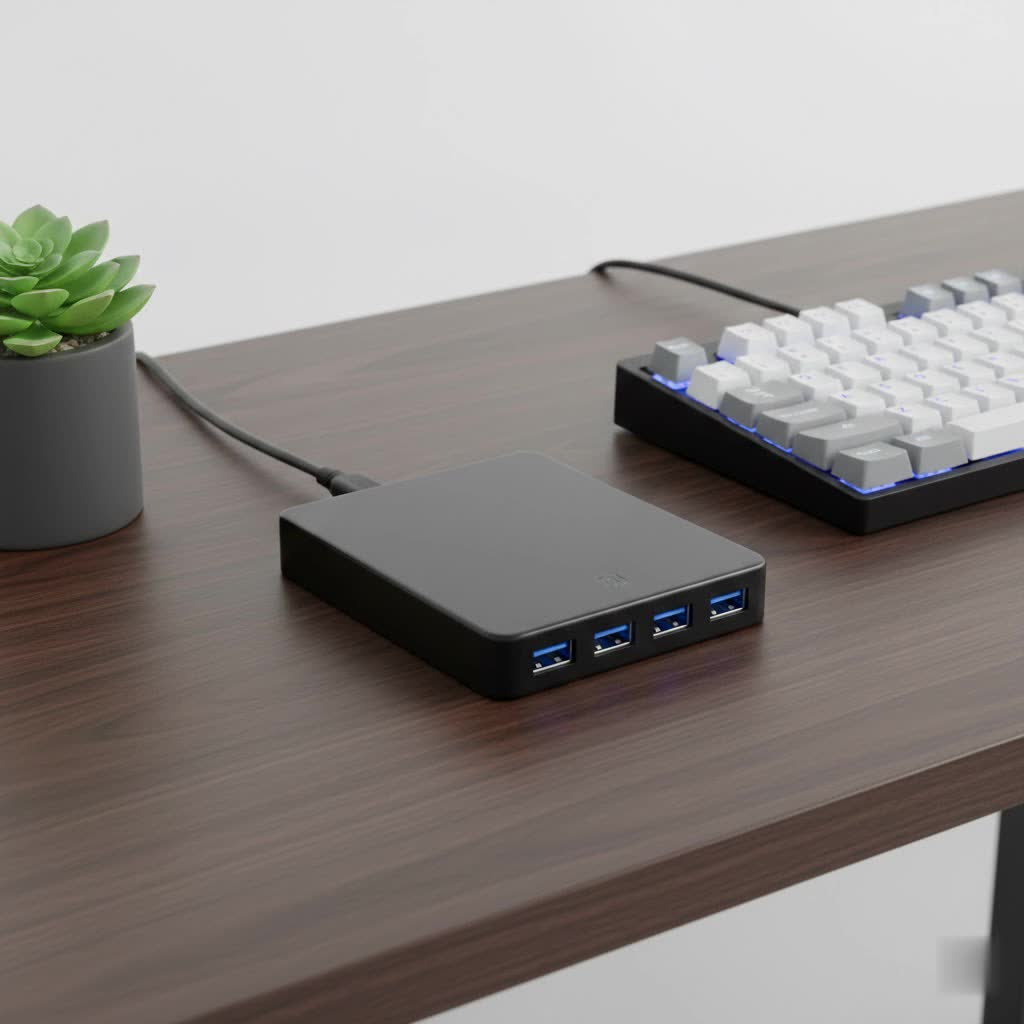
A USB hub is a device that expands a single USB port on your computer into multiple ports. Think of it as a power strip for your USB devices. Its primary function is to increase the number of available USB connections, allowing you to connect more peripherals simultaneously to one host computer. Historically, early USB hubs were simple devices, but advancements have led to sophisticated units supporting higher data speeds and robust power delivery.
Why Do You Need a USB Hub?
The need for a USB hub arises from several common scenarios. Most laptops and many desktop computers offer a limited number of built-in USB ports, which quickly become insufficient when you need to connect a mouse, keyboard, external storage, a printer, and perhaps a charging cable. A USB hub neatly solves this problem by multiplying your available ports, turning one into many. This not only expands your peripheral ecosystem but also enhances convenience and boosts productivity by keeping all your essential devices connected and ready for use. However, a standard USB hub is designed to connect multiple devices to one computer. If your goal is to share a single set of peripherals between multiple computers, a different solution is required – a USB switch.
Demystifying USB Switches
A USB switch, sometimes referred to as a USB sharing switch or KVM-style USB switch, allows multiple host computers to share one or more USB peripheral devices. Instead of expanding ports, its core function is to switch the connection of peripherals between different computers with the press of a button.
What is a USB Switch?
Unlike a hub that multiplies ports for a single computer, a USB switch acts as a control center, enabling two or more computers to take turns using the same USB devices. For example, you can connect a single printer, keyboard, and mouse to the USB switch, and then connect the switch to your work laptop and your personal desktop. With a simple toggle, you can instantly switch control of those peripherals from one computer to the other.
Why Use a USB Switch?
USB switches are invaluable for environments where you use multiple computers but want to avoid duplicating peripherals or constantly plugging and unplugging cables. Imagine having a work laptop and a personal PC on the same desk; a USB switch allows you to use the same ergonomic keyboard, high-precision mouse, and even an external hard drive or webcam with both machines, seamlessly switching control as needed. This significantly reduces cable clutter, saves money on redundant hardware, and creates a more organized and efficient workspace. Beyond dedicated switches, some USB hubs integrate a form of “switching” capability, most commonly individual power switches for each port, allowing you to control power to specific connected devices without unplugging them.
Types of USB Hubs Explained
USB hubs come in various configurations, each designed to meet specific needs regarding speed, power, and the number of devices you intend to connect.
USB Hubs by Connection Standard
The performance of your USB hub is largely determined by its supported USB standard. It’s crucial to match or exceed the standard of your computer’s USB ports for optimal performance.
- USB 2.0: Offering speeds up to 480 Mbps, USB 2.0 hubs are ideal for low-bandwidth devices like keyboards, mice, printers, and webcams. They are generally more affordable but can be a bottleneck for data-intensive tasks.
- USB 3.0 (also known as USB 3.1 Gen 1 or USB 3.2 Gen 1): With a theoretical speed of 5 Gbps (Gigabits per second), USB 3.0 hubs are ten times faster than USB 2.0. They are perfect for external hard drives, high-resolution cameras, and fast flash drives, significantly reducing transfer times.
- USB 3.1 Gen 2 (also known as USB 3.2 Gen 2): Doubling the speed of USB 3.0 to 10 Gbps, these hubs are suited for even faster external SSDs and demanding data transfers. They are backward compatible with older USB standards.
- USB 3.2 Gen 2×2: This standard pushes speeds to 20 Gbps by utilizing two lanes of 10 Gbps each, offering elite performance for the most demanding storage solutions. Compatibility requires specific host hardware.
- USB 4: The latest iteration, USB 4, leverages the Thunderbolt 3 protocol to offer speeds up to 40 Gbps, power delivery, and video output over a single USB-C connection. USB 4 hubs provide unparalleled versatility and future-proofing.
- Thunderbolt: While technically a distinct technology, Thunderbolt 3 and 4 ports often use the USB-C connector and are fully compatible with USB devices. Thunderbolt hubs and docks offer the highest bandwidth (up to 40 Gbps), supporting multiple 4K displays, external GPUs, and extremely fast storage, often acting as comprehensive docking stations with integrated USB hub functionality.
USB Hubs by Power Source
The power source of a USB hub is critical, especially when connecting multiple power-hungry devices.
- Bus-Powered USB Hubs: These hubs draw all their power directly from the host computer’s USB port. They are compact, portable, and don’t require an external power adapter. They are suitable for low-power devices like keyboards, mice, and flash drives. However, they cannot reliably power multiple high-draw devices like external hard drives or charging smartphones, potentially leading to instability or connectivity issues.
- Self-Powered USB Hubs (Active Hubs): Equipped with their own AC power adapter, these hubs draw power from an electrical outlet. This allows them to provide stable and sufficient power to all connected devices, including high-power peripherals. Self-powered hubs are essential for reliable performance when connecting multiple external hard drives, optical drives, or charging devices, ensuring consistent data transfer speeds and preventing power-related dropouts.
USB Hubs by Port Count
The number of ports on a USB hub should align with your current and anticipated future needs.
- 4-Port USB Hubs: These are the most common and compact, suitable for basic expansion needs such as connecting a mouse, keyboard, and a couple of flash drives. They are excellent for portability and minimal setups.
- 7-Port USB Hubs: Offering a good balance between expansion and size, 7-port hubs can accommodate a broader range of peripherals, including printers, external webcams, and additional storage devices, making them popular for desktop use.
- 10-Port or More USB Hubs: Designed for users with extensive connectivity requirements, these hubs cater to professional setups, creative workstations, or server environments where numerous devices, often including multiple external drives or specialized equipment, need to be connected simultaneously.
Comparison Table: USB Hubs vs. USB Switches & Their Variations
To clarify the choices, here’s a detailed comparison:
| Feature | USB Hub (Bus-Powered) | USB Hub (Self-Powered) | USB Hub (Individual Power Switches) | USB Switch (KVM-Style) |
|---|---|---|---|---|
| Primary Function | Expand ports for one computer | Expand ports for one computer | Expand ports for one computer with control | Share devices between multiple computers |
| Host Computers | One | One | One | Two or more |
| Shared Devices | Multiple devices to one host | Multiple devices to one host | Multiple devices to one host with toggles | One or more devices to multiple hosts |
| Power Source | Draws power from host PC | External AC adapter | External AC adapter | Often external AC adapter |
| Typical Use Case | Laptops, low-power peripherals | Desktops, high-power peripherals | Peripherals that need frequent resetting | Sharing KBM, printer, drives between PCs |
| Benefits | Portable, simple, cost-effective | Stable power, reliable, fast speeds | Device reset, power saving, flexibility | Saves hardware, reduces clutter, seamless |
| Drawbacks | Limited power, potential instability | Less portable, requires outlet | Slightly higher cost | Doesn’t expand ports on a single PC |
| Example Devices | Mouse, keyboard, flash drive | External HDD, multiple charging devices | USB lights, external drives, webcams | Shared KBM, printer, scanner, webcam |
How to Choose the Right USB Hub or Switch (Buying Guide)
Selecting the ideal USB connectivity solution requires a clear understanding of your specific needs and current setup. Consider these factors before making your purchase.
Assess Your Connectivity Needs
Begin by listing the devices you need to connect. Do you primarily need more ports for a single computer, or do you need to share peripherals between two or more computers? What types of devices are they (input, storage, charging)? Are fast data transfer speeds paramount for your workflow, or are basic connectivity needs sufficient? Estimating the number and power requirements of your devices will guide your decision.
Selecting the Right USB Standard
Always aim for a USB hub or switch that matches or exceeds the highest USB standard of your computer’s ports and your most demanding peripherals. If your computer has USB 3.0 ports, a USB 3.0 hub will utilize their full speed. Opting for a USB 3.1 Gen 2 or USB 4 hub, even if your current computer only supports USB 3.0, can future-proof your setup for upgrades. Remember that all USB standards are backward compatible, so a newer hub will still work with older devices, just at the slower speed.
Powering Your Peripherals
For low-power devices like a mouse, keyboard, or flash drives, a bus-powered USB hub is often sufficient due to its portability and simplicity. However, if you plan to connect power-hungry devices such as external hard drives, SSDs, optical drives, or if you intend to charge smartphones and tablets, a self-powered (active) USB hub with an external power adapter is essential. This ensures stable power delivery, prevents data loss, and guarantees consistent performance across all connected devices. If you want to manage power for individual devices, look for a hub with individual port power switches.
Port Count and Layout
Count the number of USB devices you currently use and factor in any you might add in the near future. It’s often wise to choose a hub with a few more ports than you initially need for future expansion. Also, consider the physical layout of the ports. If you have bulky USB dongles or devices, ensure there’s enough space between ports to accommodate them without obstructing adjacent connections.
Considering a USB Switch
If your primary goal is to share USB peripherals between two or more host computers, a dedicated USB switch is the solution. Consider how many computers you need to connect (e.g., a 2-port or 4-port switch) and how many peripheral inputs the switch provides. Most switches offer a simple button press for switching, while some support hotkeys for added convenience. Ensure the switch supports the USB standard required by your shared devices (e.g., USB 3.0 for fast external drives).
Brand Reputation and Value
Invest in products from reputable brands known for quality and reliability. Read user reviews and professional assessments to gauge performance, durability, and customer satisfaction. While price is a factor, prioritizing a slightly more expensive, well-built hub or switch can prevent headaches and ensure long-term stability in your connectivity setup.
Conclusion
Navigating the world of USB connectivity doesn’t have to be complicated. Whether you’re grappling with a shortage of ports on a single machine or aiming to seamlessly share essential peripherals across multiple computers, understanding the distinct roles of USB hubs and USB switches is key. USB hubs are your go-to for expanding the number of devices connected to one computer, while USB switches excel at enabling multiple computers to share a single set of peripherals, minimizing clutter and maximizing efficiency. By carefully evaluating your needs regarding speed, power, and the number of devices and computers involved, you can confidently select the perfect USB hub or switch to transform your digital experience. What’s the biggest connectivity challenge you’re currently facing in your setup?
Frequently Asked Questions
Is a USB hub the same as a USB switch?
No, a USB hub and a USB switch are distinct devices with different primary functions. A USB hub expands one USB port into many, allowing more devices to connect to a single computer. A USB switch, on the other hand, allows multiple computers to share one or more USB peripheral devices, toggling control between the host computers.
Can a USB hub share devices between two computers?
A standard USB hub cannot directly share devices between two computers simultaneously. Its function is to expand ports for a single host computer. To share USB devices between two or more computers, you would need a dedicated USB switch (or KVM-style switch) or physically move the hub’s connection between computers.
Do USB hubs slow down data transfer?
The extent to which a USB hub slows down data transfer depends on several factors, including the USB standard it supports (e.g., 2.0, 3.0, 3.1), the number of devices connected, and their power requirements. A well-designed hub matching your computer’s USB standard generally performs well, but connecting many high-bandwidth devices simultaneously can lead to shared bandwidth and a slight reduction in speed for each.
When should I use a powered USB hub?
You should use a powered (self-powered) USB hub when connecting power-hungry devices like external hard drives, optical drives, or multiple devices that charge from USB. It’s also recommended for stable connections to all peripherals, especially if you experience intermittent disconnections with a bus-powered hub, as it ensures consistent and sufficient power delivery.
Can I connect a USB hub to a USB switch?
Yes, you can connect a USB hub to a USB switch. This setup is common for sharing multiple peripherals (connected to the hub) with several computers (via the switch). For example, you could connect a USB hub with your keyboard, mouse, and webcam to the peripheral port of a USB switch, allowing two or more computers to share all those devices.
What is Thunderbolt compatibility with USB hubs?
Thunderbolt ports (Thunderbolt 3 or 4) use the same USB-C connector as USB 3.1/3.2/4 but offer significantly higher bandwidth and more versatility. You can connect a standard USB-C hub to a Thunderbolt port, and it will function at its specified USB speed. However, to leverage Thunderbolt’s full capabilities (like 40Gbps, multiple 4K displays), you would need a dedicated Thunderbolt hub or dock.
